 ASTRUM
Sass Tax
A family meeting agenda with an editable check-in sheet
Use a printable family meeting agenda to notice progress, hear each person's view, and agree on responsibilities and the next check-in.
A family meeting agenda can be a short list of decisions, rather than a long list of things someone did wrong. This original check-in sheet gives you space for appreciation, each person’s view, a few next steps, an optional shared goal, and a date to come back together.
Get the family meeting sheet
Download the editable family meeting agenda (PDF). Fill it in with a compatible PDF reader or print a blank copy. No app or account is required. Save your edited copy locally; the worksheet does not send your entries to this website.
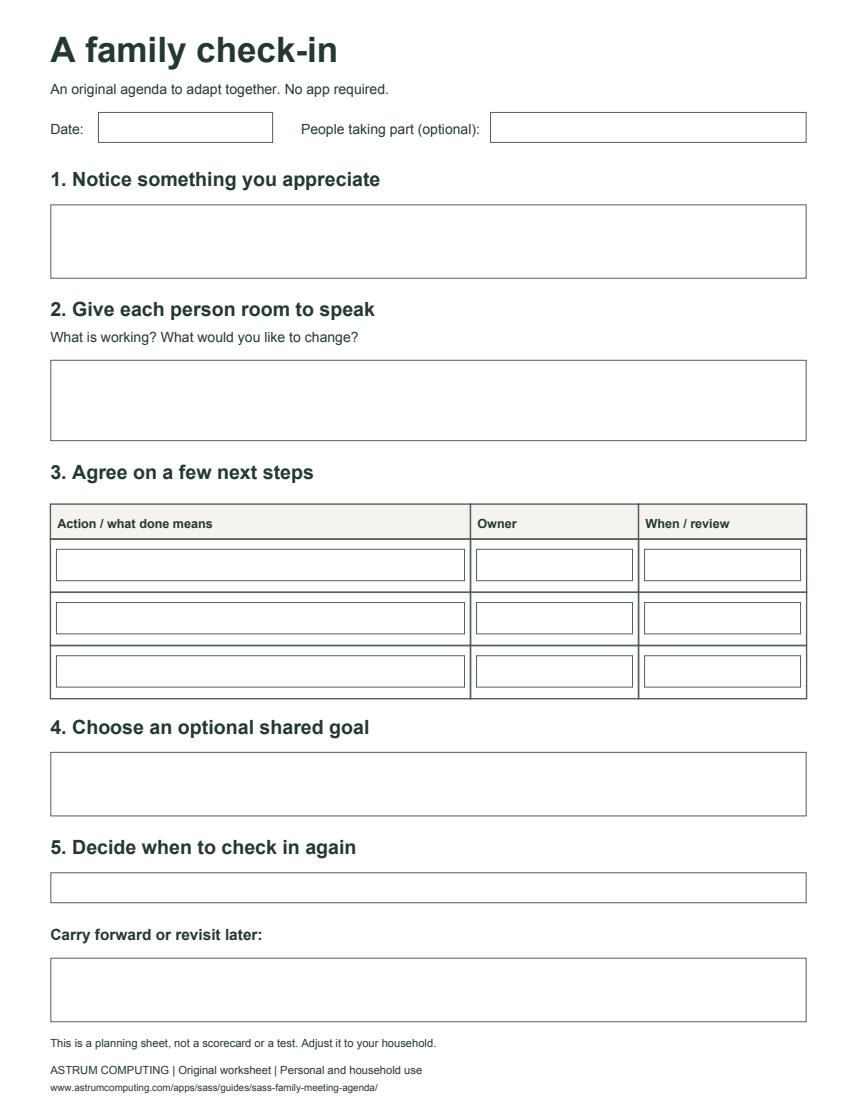
Try this five-part agenda
1. Notice something you appreciate. Start with a specific contribution: “Thanks for getting the kitchen ready before we cooked.” Leave room for everyone to offer an appreciation, rather than turning it into a comparison between people.
2. Hear each person’s view. Ask what is working and what they would like to change. Record the practical point in their words where possible. Someone can add a note later if they do not want to speak in the moment.
3. Agree on a few next steps. Write an observable action, a person who agrees to take it, and when you will review it. The sheet has three rows so you can keep this plan small; you can use fewer.
4. Choose an optional shared goal. It might be a family activity or a shared project. Leave the space blank if you do not need a group goal this time.
5. Decide when to check in again. Put the next date on the sheet and use “revisit later” for matters that need a separate conversation.
These prompts are our suggested format. For broader context, the American Academy of Pediatrics’ positive discipline guidance emphasizes listening without judgment. Our sheet is an original planning resource, not an endorsed or clinically tested program.
Turn a broad concern into a concrete agreement
Here is a fictional planning example:
- Broad concern: “The laundry is always in the way.”
- Agreed action: “Put the Saturday load away after it is dry.”
- Owner: the person who agrees to the task.
- Review: Sunday afternoon; if the machine was unavailable, agree on a new time.
The meeting sheet records the decision. A weekly chore chart can then hold the day-by-day schedule. You do not need both sheets if one is enough.
Keep responsibilities and recognition distinct
An adult’s shared household responsibility does not need to become a child-style points arrangement. Record the request, agreed owner, and a thank-you. If a child’s task has an optional reward, agree on that separately before the task starts. Use the family reward planner to record the agreement and keep earned progress separate from redeemed rewards.
Where Sass can help
Sass Tax is a parent-led app for families. Its App Store listing describes tasks, completion review, rewards, and personal or shared goals. After a meeting, enter the responsibilities your family chose. Virtual practice money does not transfer real funds.
The worksheet does not import into Sass or create an in-app meeting. You can keep using it on paper, or use the app for the ongoing task and progress record.
FROM ASTRUM COMPUTING

Sass Tax
Chores, rewards, allowances, and fair accountability for families.
See the current features, compatibility, and in-app purchases on the App Store.