 ASTRUM
Sass Tax
A family reward planner with clear expectations and review dates
Download an editable family reward planner to agree on observable actions, recognition, and review dates, with earned progress kept separate from rewards.
A reward planner is easier to understand when the agreement is written before the activity: what counts as complete, how progress is recognized, and how an earned reward is requested. This original worksheet puts those choices next to each other.
Download the planner
- Editable family reward planner (PDF): type into the fields or print in landscape orientation with “Fit to page.”
- Spreadsheet version (CSV): open it in Excel, Numbers, or a spreadsheet service and adapt the rows.
No app or account is needed. Save your own edited copy. The PDF has no submission control and does not upload entries to this website. If you import the CSV into an online service, that service handles your copy.
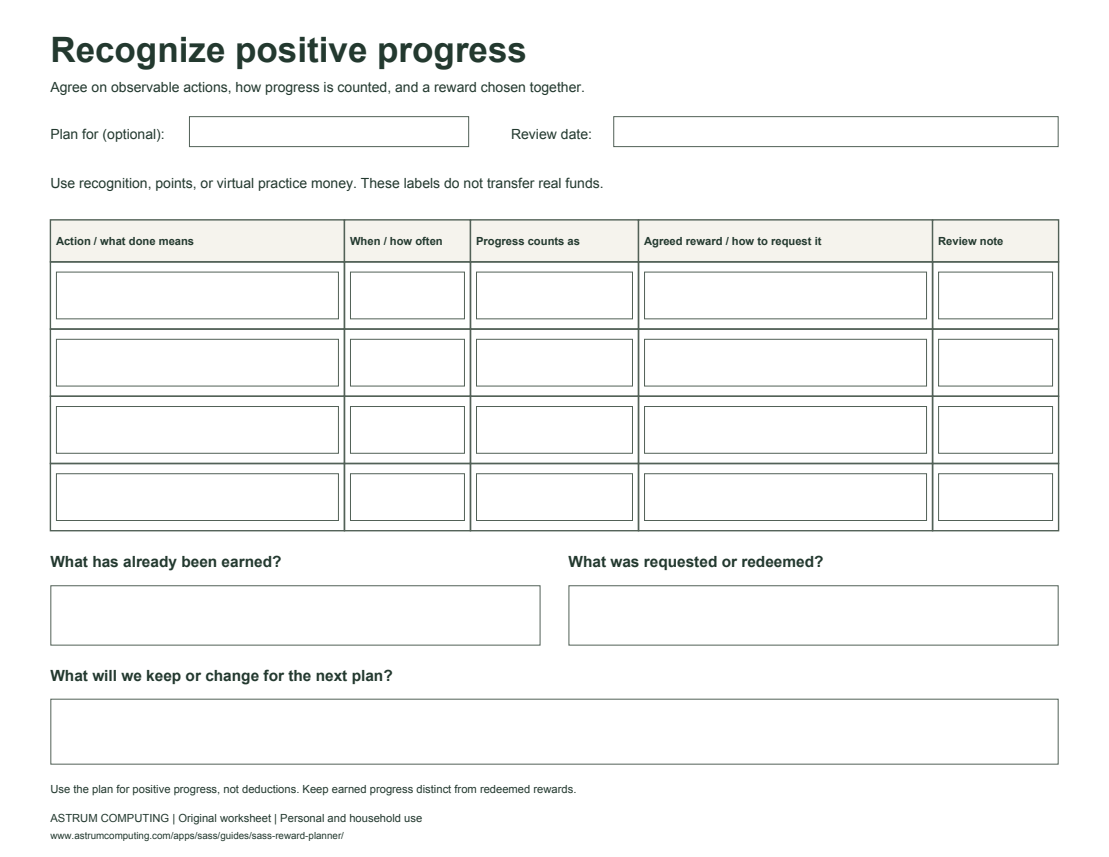
Agree on the plan together
Choose an observable action. “Put away the agreed laundry load on Saturday” is clearer to record than a broad judgment such as “have a good attitude.” Write what completion means before the review.
Choose the timing. Note whether the action happens once, on named days, or on another schedule. Avoid treating an unscheduled day as a missed opportunity.
Decide how progress counts. Recognition can be a specific thank-you, a recorded milestone, points, or virtual practice money. The sheet does not require a financial reward or a particular point value.
Choose a reward that fits your family. Invite the person working toward the goal to help choose. Examples might include choosing a family game or planning a shared activity. Agree on practical details such as timing and availability; the examples are choices to discuss, not promised app rewards.
Set a review date. Decide what to keep or change for the next version of the plan. This sheet is for positive progress, rather than a deduction ledger.
The American Academy of Pediatrics’ general resource on rewards discusses clear goals and rewards chosen with a child’s involvement. That resource is adapted from guidance for school-age children ages 5 to 12. This worksheet is our own adaptable planner and does not establish that a reward system will work for a particular family.
Separate earned progress from redemption
The two boxes below the table serve different purposes:
- Earned progress records the completed actions or recognition already agreed on.
- Requested or redeemed rewards records what was used or requested, so it is not accidentally promised twice.
For example, a family might agree on one point per completed action and a game-choice reward at three points. Those numbers are only an illustration, not Sass defaults or a recommended formula. Write the actual arrangement your family chooses.
The PDF is editable and does not calculate a balance, lock past entries, or synchronize with an app. Keep a saved copy if you want a record of the previous plan.
Using the planner alongside Sass
Sass Tax supports parent-led families. The current listing describes positive moments, rewards, permanent XP, and personal or shared goals. Its Encouragement option focuses on positives. XP and spendable rewards are different records; virtual money does not transfer real funds.
You can discuss the agreement on this sheet, then set up supported tasks and rewards in the app. Adult responsibilities use coordination and appreciation, rather than child reward points. The worksheet does not import automatically.
If the task schedule is the part you need, start with the weekly family chore chart instead. This planner is for the separate recognition and reward agreement.
For the wider household discussion, use the family meeting agenda to agree on responsibilities and a check-in date.
FROM ASTRUM COMPUTING

Sass Tax
Chores, rewards, allowances, and fair accountability for families.
See the current features, compatibility, and in-app purchases on the App Store.